
THE FORGOTTEN MIDDLE: THE MOST IMPORTANT LEADERSHIP COHORT IN ORGANISATIONS RIGHT NOW
July 23, 2026
WHY FRONTLINE AND OPERATIONAL MANAGERS MAY BE THE MOST IMPORTANT LEADERSHIP COHORT IN ORGANISATIONS RIGHT NOW
For years, leadership development has tended to focus on two groups: emerging leaders and senior executives.
Emerging leaders are seen as the future pipeline. Executives are supported to set direction, shape culture and lead from the top. But sitting between them is a large and often under-developed group of frontline and operational leaders who quietly carry much of the responsibility for turning strategy into reality every day.
In many organisations, these leaders have become the forgotten middle.
At a time when organisations are navigating AI disruption, workforce shortages, productivity pressure, culture change and rising stakeholder expectations, the ask of middle managers has never been greater. They are expected to deliver results, lead change, coach people, lift engagement, navigate complexity and keep teams moving, often all at once.
That creates a clear tension. Middle managers are becoming more important to organisational performance, while often receiving less targeted development than the leaders above and below them.
The impact of this could be reflected in the decline of manager engagement as highlighted in a recent
Gallup report. The report cites that manager engagement declined from 27% to 22% between 2024 and 2025, with part of this decline likely linked to managers being asked to implement significant workplace change without always having the formal management skills or support to do it well.
For Learning & Development and People & Culture leaders, this raises the question around what's being done to develop this cohort of leaders, and could they be one of the biggest untapped levers of organisational performance?
The Growing Importance of Middle Managers
Research continues to show just how much managers shape organisational outcomes. Studies suggest managers account for around 70% of the variance in employee engagement between teams, while manager quality remains one of the strongest drivers of retention and employee experience. Edelman’s 2023 Trust Barometer also reinforces the local influence of managers during uncertainty, showing that employees place high trust in workplace sources of information, including the people closest to their day-to-day work. This matters because engagement, culture and performance are not experienced through strategies or organisational charts. They are experienced through everyday interactions with local leaders.1
Today, frontline and operational managers are often responsible for:
- Translating strategy into action
- Shaping employee experience
- Prioritising competing demands
- Allocating resources
- Leading change initiatives
- Coaching performance
- Reinforcing culture
This puts middle managers right in the centre of where organisational strategy meets execution. They are also often the people with the informal networks, trust and local context required to make change real. Quy Huy’s Harvard Business Review research found that middle managers can be powerful allies in major change because they are better positioned than senior executives to leverage informal networks, surface entrepreneurial ideas, and maintain momentum through the emotional realities of transformation.2
If the strategy is the blueprint, middle managers are the builders constructing the way work actually gets done.
Why This Cohort gets overlooked
In many organisations, development investment gravitates towards the beginning and end of the leadership pipeline. Graduate and emerging leader programs receive considerable attention. Executive leadership programs and coaching attract significant investment, in fact data suggests that executive and high-potential leaders can attract 2.5x more development investment than middle managers.
"Middle managers often sit in between and can be seen as experienced enough to get on with the job, and too operationally important to step away from it for development."
The consequence is that the leaders with the greatest influence on day-to-day performance can become the least intentionally developed.
The Forgotten Middle in Numbers
- Managers influence over 70% of team engagement outcomes.
- Manager quality remains one of the strongest predictors of employee retention and employee experience.
- Manager engagement has declined from 27% to 22% since 2024.
So what Capabilities Do Modern Middle Managers Need?
While the fundamentals of good leadership still matter, we believe today’s frontline and operational managers need capability across four connected domains.
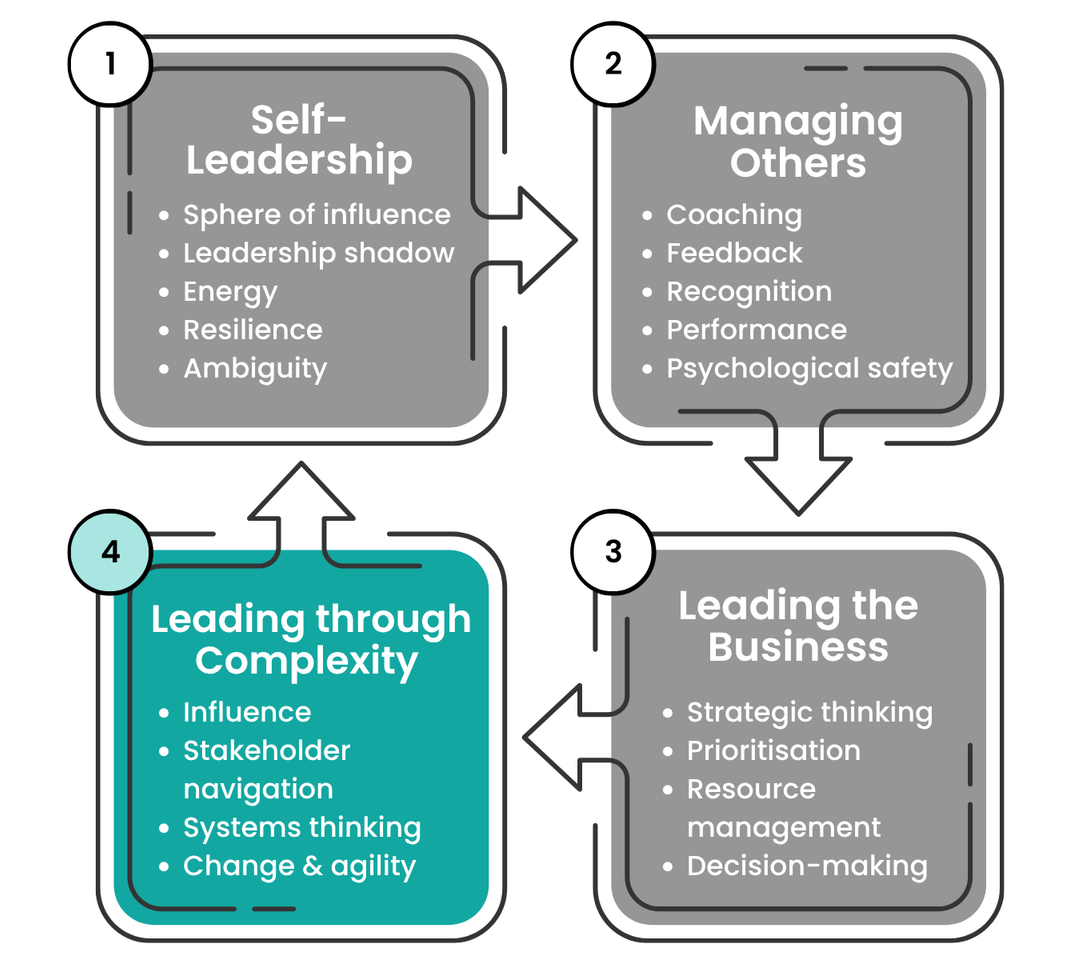
1. Self-Leadership
The first challenge is learning to lead yourself well.
Middle managers often carry high accountability while having limited control over many of the variables affecting their work. They sit between organisational priorities, customer expectations, workforce needs and operational realities.
As a result, effective leaders need the ability to:
- Understand their sphere of control and sphere of influence
- Recognise and manage their leadership impact
- Demonstrate self-awareness
- Regulate emotions under pressure
- Manage energy, focus and priorities
- Build resilience
- Navigate ambiguity and uncertainty
More than ever, these leaders need to know where to focus their effort and influence, rather than trying to control everything around them.
2. Managing Others
Many middle managers move into leadership because they are technically strong. But their future success depends less on being the expert and more on their ability to create success through others. This is a step-change for many leaders and often requires a structured learning path to build the confidence and acquire the tools to do this well.
Managing others well requires skills such as:
- Coaching
- Providing feedback
- Recognition
- Accountability & difficult conversations
- Development discussions
- Building team effectiveness
- Performance management
- Creating psychological safety
For many of our clients we've seen leadership development centred on improving the quality and frequency of critical leadership conversations, including coaching, feedback, recognition and career development. The insight was simple: leadership capability is built in the moments that happen every day.
3. Leading the Business
Middle managers aren't just people leaders; they're business leaders as well. Increasingly, their role is expected to turn strategic intent into operational outcomes, often while balancing competing priorities, limited resources, changing expectations and today, an ever-evolving landscape of AI and business evolution.
To be truly effective in their roles, middle managers also need to be able to:
- Think strategically
- Prioritise across multiple demands
- Manage commercially
- Make operational decisions
- Manage resourcing
- Improve productivity
- Manage performance
Organisations often assume managers instinctively know how strategy should translate into day-to-day action. In practice, this often requires explicit development, shared language and practical tools. BCG’s transformation research reinforces this point, highlighting the importance of cascading the case for change through leadership layers and ultimately to frontline leaders, with employees needing clear communication on the why, what and how of change.3
4. Leading Through Complexity
This leads us to the most defining challenge for today’s middle manager, leading in environments where there is no clear playbook. Organisational change, competing stakeholder expectations, rapid technological shifts, workforce pressure and shifting priorities mean leaders are increasingly required to make decisions without all the information they'd like. The ability to lead through this type of complexity and ambiguity is therefore becoming core to the role, and the key to businesses translating strategy into outcomes.
Leading through complexity requires managers to be able to:
- Create clarity amidst ambiguity
- Influence without necessarily having authority
- Navigate stakeholder dynamics
- Manage competing priorities
- Lead change and transformation
- Apply systems thinking
- Build agility and adaptability
The leaders who succeed are not always the ones with all the answers. They are often the ones who can create confidence, focus and momentum when the answers to questions are still emerging. This is why middle manager capability is not just a development issue; it is an execution issue. McKinsey has reported that organisations with top-quartile managers realise three to 21 times greater five-year total shareholder returns compared with organisations whose managers sit in the other three quartiles.4
The Opportunity for L&D and P&C Leaders
Many organisations are investing heavily in culture transformation, technology, AI adoption, capability building and organisational change.
But almost every one of these initiatives relies on middle managers to deliver the outcomes and bring it to life.
Assessing where you middle managers are at, understanding the unique challenges of their role and investing in their development could be not only a huge step towards setting them up for success, but also a giant leap forward for your organisation in terms of strategy implementation and sustained performance.
A great question to ask yourself at this point might be....
"How are we developing the leaders who influence culture, performance and execution every day?"
The organisations that can answer this question well may find they have been sitting on one of their most powerful performance levers all along.
We absolutely believe that the future of organisational performance will not be determined by strategy alone, but be shaped by whether frontline and operational managers have the capability, confidence and support to influence people, navigate complexity and translate strategy into everyday action.
GETTING STARTED
If you are looking to strengthen the capability of your middle managers, Spring Point can help. Our Frontline Leaders pathway is designed to equip frontline and operational leaders with the practical skills, shared language and tools they need to lead well in today’s environment.
Get in touch to learn more. We'd love to chat!
Leadership Development in Practice



- Edelman, 2023 Edelman Trust Barometer, global report and methodology.
- Nguyen Huy, “In Praise of Middle Managers,” Quy Harvard Business Review, September 2001.
- Boston Consulting Group, “What Works—and What Doesn’t—in Transformation,” 2021.
- McKinsey & Company, “On Point: Middle managers are vital to organisational health and performance,” 2023.
- Prosci, Best Practices in Change Management, 11th Edition, 2020.